
Male Maldives: Malé City Guide, Sights and Getting Around
Guide to Malé, the Maldives capital: sights, transport, etiquette and stays, sourced to official bodies.
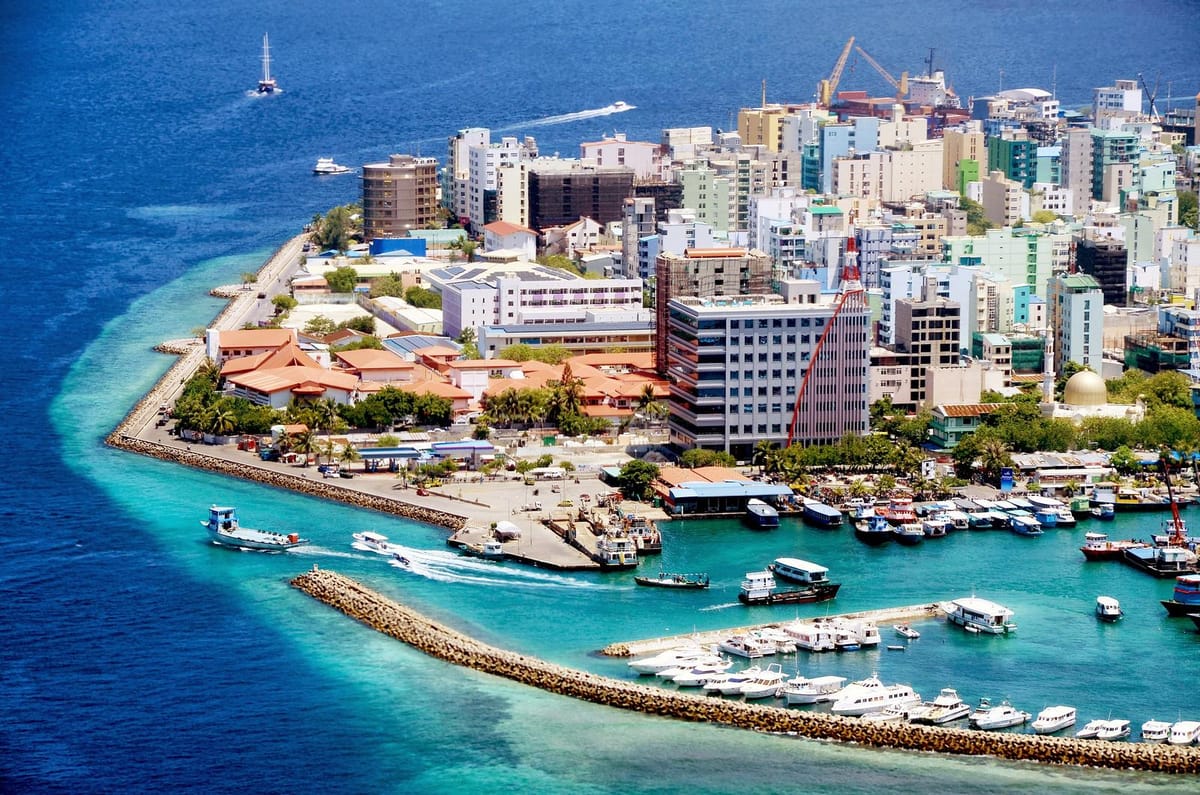
Malé (also written Male or Male') is the capital of the Maldives, a dense city island in Kaafu Atoll, which Visit Maldives also calls Malé Atoll. Most visitors only pass through it on the way from Velana International Airport (formerly Ibrahim Nasir International Airport, code MLE) to a resort or guest house, but it is the place to see the Maldives that most Maldivians live in. If you searched for "male maldives", "male city" or "male town maldives", this guide covers the sights, transport and the rules that apply. Information is as of November 2026.
This page sits alongside our Maldives travel guide. Check operators for current fares.
Male Maldives: what the city is
Malé is the seat of government and the country's main transport hub. Visit Maldives, the national tourism board, says that "Greater Malé is the central hub for domestic transportation within the Maldives", and notes that the Maldives is a 100 per cent Muslim country (Visit Maldives).
How big is Malé?
The Maldives Bureau of Statistics counted 211,908 resident people in "Male' (including Villimale and Hulhumale)" in the 2022 census, out of 515,132 for the whole country (Census 2022 report). The report describes Malé as one of the most densely populated cities in the world, with an area of just 5.8 square kilometres. Other census tables are on the Bureau's Census 2022 releases page.
The report defines this "Male'" group as the four wards of Malé (Henveiru, Galolhu, Machchangoalhi and Maafannu), plus Hulhumalé, Villimalé and Hulhulé with its harbour. Of the 211,908 residents, 51,721 were foreigners (24.4 per cent). The census counts only people who live in the Maldives for a year or more, so tourists and short-term visitors are not included. The report gives no separate figure for the four Malé wards alone.
Male city: landmarks and things to see
Visit Maldives says Malé "is home to some of the most intricate and beautifully crafted mosques in the world". Opening hours change, so ask your guest house or hotel before you set out.
Hukuru Miskiy (Old Friday Mosque) and Munnaaru
Visit Maldives lists Hukuru Miskiy and its minaret, the Munnaaru, among its places to see in Malé City, in Henveiru. Its place page says the mosque was built in 1658 and the minaret in 1675, with interlocking coral blocks, cut coral columns and traditional woodcarving and lacquer work. It says the graveyard beside the mosque dates from the 17th century, and that rounded tombstones mark women's graves and pointed ones mark men's. It is a working mosque, so dress modestly and follow any instructions on site.
Is Hukuru Miskiy a UNESCO World Heritage site?
Not on UNESCO's own records that we found. Visit Maldives says the mosque was declared a World Heritage site in 2008, but UNESCO's World Heritage Centre shows no inscribed World Heritage property for the Maldives and lists the "Coral Stone Mosques of Maldives" on the Maldives' tentative list, not as an inscribed site. The entry was submitted on 19 February 2013 by the Ministry of Tourism, Arts and Culture, and it covers six mosques: the Malé Friday Mosque, the Malé Eid Mosque, and mosques in Ihavandhoo, Meedhoo, Fenfushi and Isdhoo (UNESCO tentative list entry). A tentative list is a country's shortlist of sites it may later nominate. It is not a World Heritage listing.
The entry's text, which UNESCO says is the responsibility of the Maldives government, says the Malé Friday Mosque was built in 1658 during the reign of Sultan Ibrahim Iskandhar I, replacing a mosque from 1153. It describes a complex with a minaret, coral stone wells, a sundial and a cemetery. It calls the Malé Eid Mosque a "living heritage" that older residents still prefer for prayer. Visit Maldives gives the same 1658 date for Hukuru Miskiy. UNESCO's description calls the building the Malé Friday Mosque, while its authenticity statements use the name Hukuru Miskiy for the Malé mosque.
Sultan Park
Visit Maldives calls Sultan Park "a small green oasis with winding alleyways perfect for a quick break."
National Museum
The National Museum is run by the National Centre for Cultural Heritage, which gives its address as Chaandhanee Magu, Malé. The Centre says it was the first museum in the Maldives, opened on 19 November 1952, National Day, and first used a building called Usgekolhu, built at the start of the 20th century. A larger building, funded by the Chinese government, was added after a project began in 2002. The Centre says the museum holds more than 7,000 artefacts in three sections: an ancient period (before Islam arrived in 1153), a medieval period up to the early 19th century, and a contemporary period from 1800 to the present. Most exhibits come from the medieval period and include ornaments and garments of kings and queens. The Centre's website gives opening days as Saturday to Thursday, except on government and public holidays, with visiting hours of 10:15 to 16:00 and the ticket counter open from 10:15 to 15:30. Check before you go (National Museum).
Muleeaage
Visit Maldives describes Muleeaage as the official palace of the President and "a must-see in any Male' tour". It says the palace was built between 1914 and 1919 by Sultan Mohamed Shamsuddeen III for his son, Prince Hassan Izzuddeen, and that it never served as a Sultan's palace (Visit Maldives). Because it is a working official residence, check with your guest house or a guide whether you can get close.
Republic Square and the harbour
Visit Maldives says most speedboats heading to local islands leave from the jetty near Republic Square in Malé city, so it doubles as a departure point.
Getting around Male city and to the airport
Velana International Airport is on Hulhulé island, linked to Malé by the Sinamalé Bridge, which opened in 2018. A road continues from the airport to Hulhumalé. The airport's transport guide lists the public airport ferry (MVR 15 as of November 2026, every 15 minutes from 5:30 am to midnight, arriving at the Hulhumalé Ferry Terminal in Malé), regular buses to Hulhumalé and Malé, taxis that run 24 hours across the bridge link, and private speedboats.
For other islands, Visit Maldives notes that MTCC ferries do not travel to every island. Speedboats to local islands usually leave from the jetty near Republic Square.
Ferry to Villimalé
MTCC, the Maldives Transport and Contracting Company, publishes a Villimalé ferry timetable on its schedules page, and the 2026 version runs through the night. From Sunday to Thursday the first departures are at 05:30, ferries leave every 15 minutes until 06:00, every 10 minutes from 06:00 to 07:00, every 5 minutes from 07:00 to 08:00 and every 10 minutes from 08:00 until midnight. After midnight the gaps widen to 30 minutes, then one hour from 02:00 to 05:00. Friday has a Friday prayer break from 12:00 to 13:30, and Saturday and holidays have a similar timetable. The same page lists separate MTCC timetables for the Thilafushi and Gulhifalhu ferries. Timetables change, so check the page and call MTCC on 1650 if in doubt.
Buses and tickets
RTL (Raajje Transport Link), the ferry and bus network operated by MTCC, says all Greater Malé bus routes are fixed-fare, so you tap in once when you board. Buses take EMV (Europay, Mastercard and Visa) contactless cards issued by BML and other banks. Greater Malé ferry tickets can be bought as a QR ticket on the RTL website or app, paid with a contactless card, or bought on a ferry counter. Single-journey QR tickets stay valid for seven days, and Greater Malé ferry tickets are not refundable (RTL FAQ). The airport's transport guide also names taxi booking apps for Malé and Hulhumalé and says taxis run 24 hours.
Dress code and etiquette in Malé
Visit Maldives says visitors are expected to respect the way of life on local islands, such as wearing modest clothing in public. It says bikinis are fine at resorts but not on local islands unless there is a designated "Bikini Beach" (first-timers guide).
- Alcohol is served at resorts and liveaboards and is prohibited on local islands, according to Visit Maldives. Individuals may not import it.
- Dress modestly in public, and especially at mosques.
- Ask before photographing people.
Where tourists stay in Malé
Visit Maldives says that staying at a hotel in Malé is convenient for business visitors. Many tourists choose Hulhumalé instead, which sits beside the airport. See our Hulhumalé guide. For beach stays, see Maldives local islands.
The Ministry of Tourism's register of guest houses, generated on 20 November 2026, lists 86 guest houses with the island recorded as Malé. Of these, 59 are in Hulhumalé and 27 are in other parts of Malé, mostly Henveiru, Maafannu and Machchangoalhi, with 579 rooms between them (register). Numbers change as properties open and close.
Health care in Malé
Visit Maldives says the main public hospital, Indira Gandhi Memorial Hospital (IGMH), and the private hospitals ADK and Treetop are in Malé (travel information). It adds that every atoll has at least one hospital, and most resorts have their own clinics and doctors.
Frequently asked questions
Is Male the capital of the Maldives?
Yes. Malé, also spelled Male' or Male, is the capital, in Kaafu Atoll (also called Malé Atoll).
Is Male city worth visiting?
It suits a short stop. Hukuru Miskiy, Sultan Park, the National Museum and the harbour are in the city. It is not a beach destination.
How far is Male from the airport?
Velana International Airport is on Hulhulé, joined to Malé by the Sinamalé Bridge. The airport lists a public ferry, buses, taxis and private speedboats.
Can you drink alcohol in Male?
Visit Maldives says alcohol is served at resorts and liveaboards and prohibited on local islands. Individuals may not import it.
What should I wear in Male city?
Visit Maldives asks for modest clothing in public. Save swimwear for resorts and designated bikini beaches.
Is Hukuru Miskiy a UNESCO World Heritage site?
UNESCO's World Heritage Centre lists the Coral Stone Mosques of Maldives, including the Malé Friday Mosque and Eid Mosque, on the tentative list, not as an inscribed site. Visit Maldives says 2008, but we found no UNESCO record of an inscription.
Is there a ferry from Male to Villimale?
Yes. MTCC publishes a Villimalé ferry timetable with departures through the night. Sunday to Thursday ferries run every 5 to 15 minutes in the morning, and Friday has a prayer break from 12:00 to 13:30.
What is in the National Museum in Male?
The National Centre for Cultural Heritage says it holds more than 7,000 artefacts in ancient, medieval and contemporary sections, with many items from the reigns of sultans.
Does Male have buses?
RTL runs Greater Malé buses on fixed fares, payable by contactless card. RTL buses also link the airport with Hulhumalé and Malé, according to the airport.
What is the population of Male?
The 2022 census counted 211,908 residents in Malé including Villimalé and Hulhumalé, of whom 51,721 were foreigners living in the country. It gives no figure for the four Malé wards alone.
Where do tourists stay in Male Maldives?
Some stay in Malé hotels, but many use Hulhumalé or go straight to a resort or local island. See our Hulhumalé guide.