
Maldives Whale Sharks: Where, When and the Rules for Swimming with Them
Whale sharks are seen in the Maldives all year, most reliably in South Ari Atoll's marine protected area. This guide covers seasons by atoll, the protected-area rules and the whale shark visitor rules.
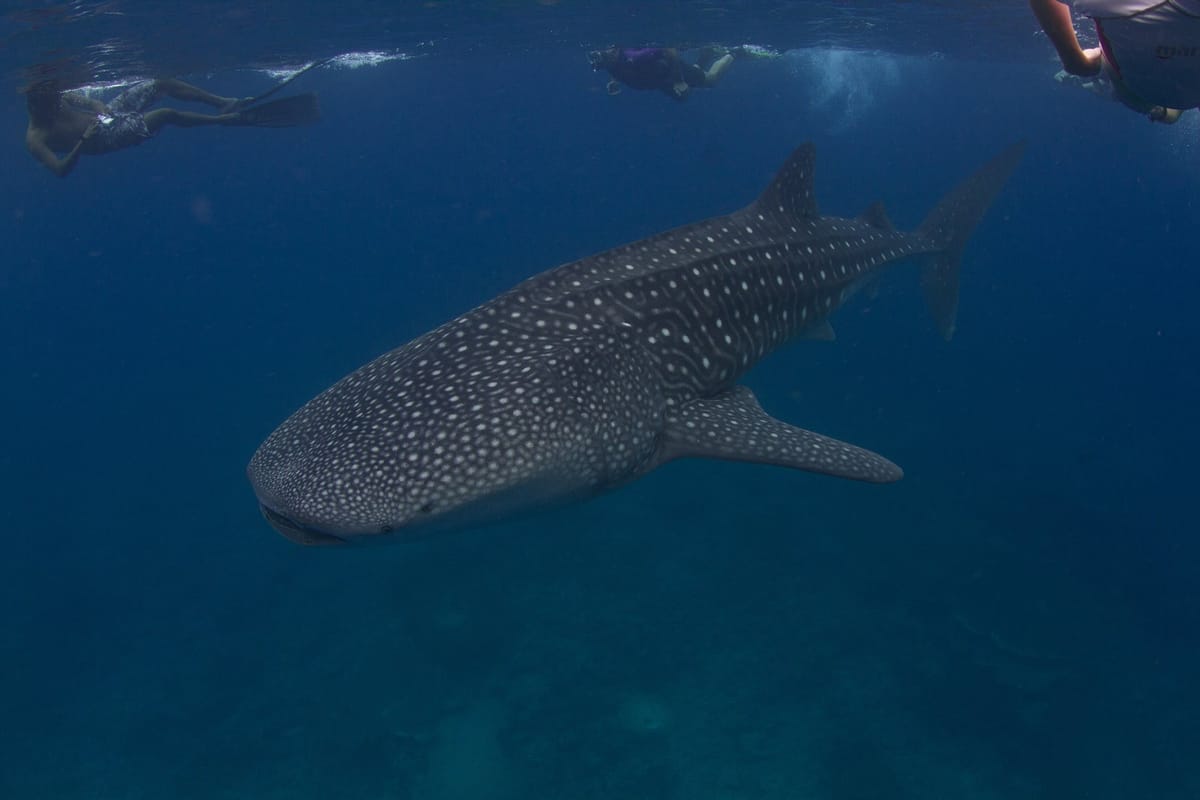
The Maldives has whale sharks all year, and the most dependable place to find them is South Ari Atoll, where a marine protected area covers the main reef. Visit Maldives says they can be seen there year round, and the Maldives Whale Shark Research Programme (MWSRP) says the area has the highest re-sighting rate of any whale shark hotspot in the world. This guide covers where and when to see them, the rules in place, and how to behave in the water. Information is as of November 2026. See also our manta ray guide, Hanifaru Bay guide and diving and snorkelling guide.
Best place to see whale sharks in the Maldives
Visit Maldives has a page for each main area:
- South Ari Atoll: a marine protected area with a year-round aggregation. Visit Maldives says individuals show high site fidelity, meaning the same animals are often seen again, and that the usual behaviour is cruising.
- Baa Atoll: whale sharks arrive for the plankton at Hanifaru Bay. Visit Maldives gives the aggregation period as May or June to October or November.
- Gnaviyani Atoll (Fuvahmulah): Visit Maldives says sightings are year-round, with higher probability in December and April, and that most are large females averaging 8 metres.
The MWSRP guide adds that whale sharks have been recorded across the Maldives, and that some individuals appear to move between atolls at about the same time each year, probably following seasonal food.
Best time to see whale sharks in the Maldives
For South Ari Atoll there is no closed season: Visit Maldives says the aggregation is year round. MWSRP likewise calls it a naturally occurring year-round aggregation. In Baa Atoll the window is the Southwest Monsoon months, roughly May to November, and Fuvahmulah is year-round with December and April named. For weather by month, see our weather guide.
Year-round does not mean guaranteed. Encounters depend on the day, the water and the animals.
South Ari Marine Protected Area (SAMPA)
The government protected-areas portal lists the South Ari Marine Protected Area as designated on 5 June 2009, covering 5,610.58 hectares, in IUCN Category VI (habitat and species management area). Its description says whale sharks can be seen throughout the year and that the area also has turtles, manta rays and several shark species.
The portal's rules for the area prohibit, among other things:
- anchoring;
- feeding any species of marine life;
- touching or abusing protected species;
- lighting up the area at night;
- disturbing species through noise;
- littering, and taking coral, sand or rocks.
The portal shows a booking slot length of 30 minutes and a fee of MVR 0 per person for snorkelling and diving as of November 2026. It lists a hotline, 7448300, and says to contact the office if you are unsure which visitor type you are.
Whale shark rules in South Ari
Whale sharks have been protected by Maldivian law since 1995, according to MWSRP, and the species is listed as endangered by the IUCN. In South Ari the detailed rules are in the SAMPA management plan. The government portal carries an unofficial English translation of the consolidated version dated 6 September 2026 (the Dhivehi text is the official one). Among its rules for visitors:
- get a permit before you visit, through the hotline or the booking system;
- snorkelling and freediving are allowed from 6:00 a.m. to 6:00 p.m.;
- keep at least 3 metres from the body of a whale shark and 4 metres from its tail, and do not go beyond its head to look at it;
- no more than 60 people in the water at one time inside the 250-metre contact zone around a whale shark, and a maximum of 15 minutes per person in the water if others are queuing;
- at least one SAMPA Guide for every six passengers on a whale shark snorkelling trip;
- vessels stay at least 15 metres from the nearest whale shark, go below 5 knots in the contact zone and below 2 knots within 50 metres of the animal, and no more than six vessels, including the ranger vessel, may work the contact zone for whale shark snorkelling;
- scuba diving is prohibited where vessels are operating for whale shark snorkelling and inside the contact zone.
Older figures still circulate. The Environmental Protection Agency's tourist encounter guidelines of 5 June 2009, reproduced in MWSRP's 2021 guide, gave different numbers, for example 12 swimmers from one vessel and 10 metres for vessels. MWSRP's guide also asks visitors not to touch or ride a whale shark, not to swim on top of it, not to use flash, to enter the water seated instead of jumping, and to keep noise down. It noted in 2021 that many vessels did not follow the 2009 guidelines because of limited enforcement, so a good operator briefs you before you enter the water. Rules can be updated, so ask your operator or the Environmental Protection Agency for the current version.
What to expect in the water
MWSRP's data describe the typical South Ari whale shark: around 80% are male, all are juvenile by size, and the average estimated length was 5.77 metres as of 2019. The average encounter lasted 15.3 minutes in that year. MWSRP says the shark's usual behaviour is slow cruising near the surface, and that interrupting it, for instance by crowding, can make the shark leave. Signs that a shark feels threatened include fast swimming, abrupt turns and turning its back toward you. Back away if you see them.
MWSRP's database, called the Big Fish Network, held 526 individual sharks as of March 2021. MWSRP says every whale shark has a unique spot pattern, which scientists use to tell individuals apart.
Whale shark tours and who runs the research
We list no operators or prices here. Most encounters are run by resorts, guesthouses and dive centres in South Ari Atoll. MWSRP (now called Maldives Whale Shark Research on its website) is a Maldivian NGO that has studied the population since 2006, and its site says visitors can join its research vessel to help collect data. Its website is being rebuilt, so check its Facebook or Instagram pages for the latest.
Frequently asked questions
Where is the best place to see whale sharks in the Maldives?
South Ari Atoll, according to Visit Maldives and MWSRP, because the aggregation there is year-round. Baa Atoll and Fuvahmulah also have sightings.
What is the best time to see whale sharks in the Maldives?
South Ari has them throughout the year. Baa Atoll's season runs roughly May to November, and Fuvahmulah has December and April highlighted by Visit Maldives.
Can you swim with whale sharks in the Maldives?
Yes, by snorkelling with a guide, with a permit and under the SAMPA rules: no touching, at least 3 metres from the body and 4 metres from the tail.
Is there a fee to see whale sharks in South Ari?
The government portal lists MVR 0 per person for snorkelling and diving in the protected area as of November 2026. Tour operators set their own charges for the trip, which we do not cover.
Are whale sharks protected in the Maldives?
Yes. MWSRP says whale sharks have been protected by Maldivian law since 1995, and the portal lists South Ari as a marine protected area since 2009.
Can you dive with whale sharks in the Maldives?
The portal lists diving as a bookable service in South Ari, but the management plan prohibits scuba diving inside the 250-metre contact zone around a whale shark and where vessels are working for whale shark snorkelling. A diver who sees a whale shark must not chase, touch or block it.