Maldives at COP31: Right of islanders to stay on islands
President Dr Mohamed Muizzu told a COP31 session on sea-level rise that the Maldives' priority is to protect the right of its people to remain on their islands. He asked for grant-based adaptation support and predictable climate finance.
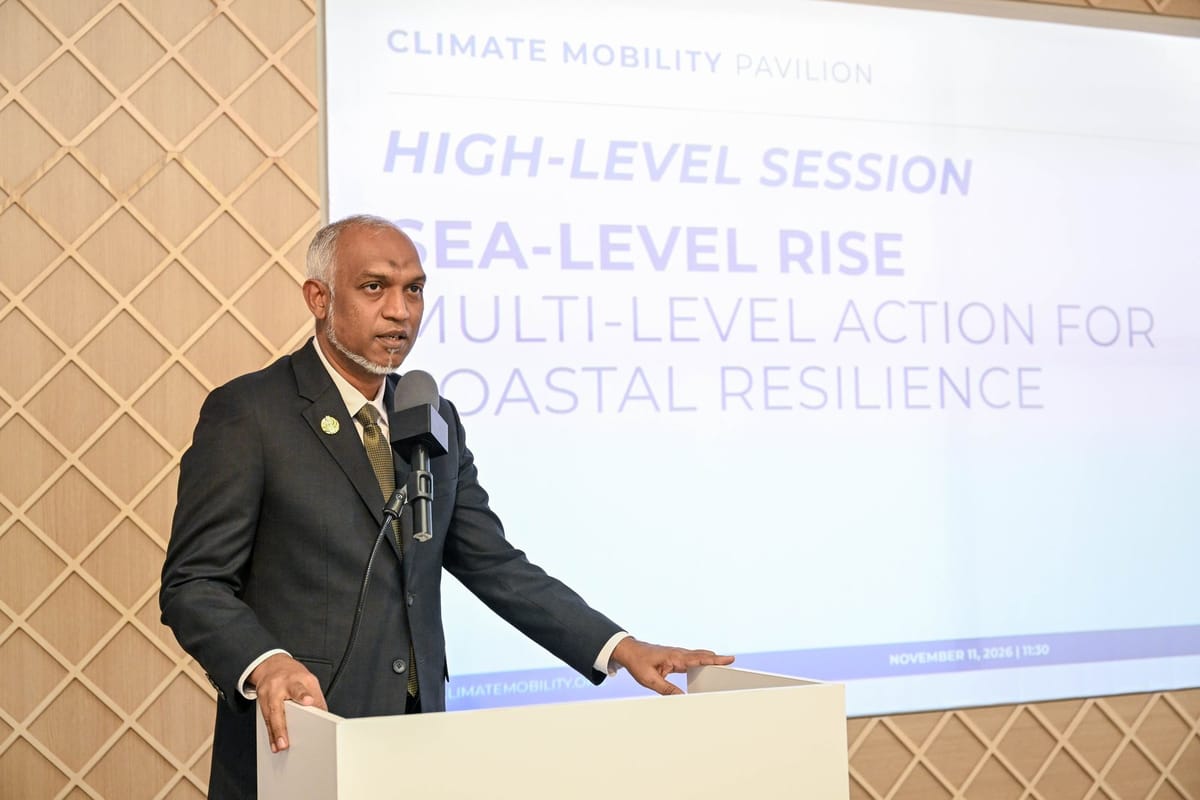
President Dr Mohamed Muizzu has said the Maldives' priority on sea-level rise is "to protect the right of our people to remain on our islands", in a statement to a high-level session at COP31 published by the President's Office. The statement is dated 12 November 2026. The session, "Sea-Level Rise: Multi-level Action for Coastal Resilience", was organised by the United Nations Global Centre for Climate Mobility.
The President called sea-level rise "an immediate development challenge and an existential one" for the Maldives. "Our islands are not simply land. They are our homes, our history and our identity," he said. Loss of even a small part of the territory, he added, "strikes at our sovereignty, our heritage and our future".
Islands, reefs and new cities
On the islands, the President said the Maldives is protecting shorelines and safeguarding the reefs and mangroves that are "our most effective natural defences". For this, he said, communities must have the data and the finance to lead adaptation.
At the national level, he pointed to Hulhumalé, an elevated island city that he called a strategic investment in the country's climate security. The Maldives is now developing RasMalé, designed above projected sea-level rise, as a low-carbon eco-city powered by renewable energy.
He said both reflect a conviction that "adaptation must be built into development, not added after disaster". He tied this to his vision for the Maldives to become a fully developed nation by 2040. "A developed Maldives must also be a resilient Maldives," he said.
What he asked for
The President set out three requirements. Climate mobility must be part of adaptation planning. Climate finance must be "adequate, predictable and accessible". Adaptation support must be "grant-based, not charity". "It is climate justice," he said.
He said climate vulnerability "must not and will not dictate our future". "We want our communities to remain on their islands. We want our children to build, prosper and thrive in the land of our ancestors," he said. The future of the islands, he added, "must not be determined by rising seas, but by our collective resolve to protect them".
Maldives Now has also reported Muizzu's call for climate grants rather than costly loans for small islands at COP31.